
Explore Raymore City Directory Collections
Raymore's historical directory shelf is really several related collections rather than a yearly municipal roll. The one confirmed digitized directory is a county-wide work from 1908. Library microfilm, newspapers, family collections, deeds, tax records, and Historical Society files supply other dated connections. Microfilm and newspapers both help. So do deeds and tax records. Each source deserves its own citation and its own limit. A newspaper notice or a deed party, in particular, is not automatic proof. It does not confirm a person's later residence.
| Collection | Years | Where Held | Access |
|---|---|---|---|
| History and Directory of Cass County, Missouri | 1908 | Digitized by Google Books; Cass County research context | Free digitized book |
| Raymore Journal | Library run Jan. 3, 2001 to Dec. 28, 2002; SHSMO directory lists 1992-current | Cass County Public Library and State Historical Society catalogs | Catalog and issue access vary |
| Cass County Democrat | 1881-1956 | Cass County Public Library microfilm | In-person microfilm research |
| Democrat-Missourian | 1957-Apr. 28, 2017 in library list | Cass County Public Library microfilm | In-person microfilm research |
| Crouch and CCHS historical collections | Collection-specific | Genealogy Branch and Cass County Historical Society, Harrisonville | Digital collection, inquiry, or appointment |
| Missouri Digital Heritage directories | Hannibal 1859-1925; St. Louis 1872-1900 | Missouri Secretary of State collection | No Cass or Raymore annual run located |
The table starts with a hard limit. No annual Cass or Raymore city-directory run survives in the available collections. The 1908 volume is valuable. It contains a Raymore chapter, a general directory, and a county directory. Even so, it stands as a single historical snapshot. A missing name may reflect a gap. It could be in publication, indexing, custody, or scope. This is not a conclusion about the person.
Raymore City Directory: One 1908 Snapshot
A.L. Webber's fully digitized History and Directory of Cass County, Missouri runs 408 pages. The Cass County Leader published it. Its contents place the Raymore chapter around page 353. The general directory falls around page 366, and the county directory around page 372. Cite the book title and the printed page in any historical note. The page reference lets another researcher test the reading later.
The book's county-wide scope matters. A name may appear because of a business, a public role, or a family tie. It may also appear through a county connection. It does not create an annual sequence before or after 1908. It cannot establish a current address either. The official Cass County ebook adds county history and business-directory material. That source also needs a date and a page-based citation.
Raymore City Directory Gaps Matter
The Missouri Digital Heritage city-directory collection covers Hannibal and St. Louis online, and it lists no Cass County or Raymore annual run. No official Cass or Raymore reverse directory appears either. A criss-cross directory sorts people by street instead of name. A catalog or a physical volume could confirm one. Until then, treat it as unavailable for local work.
Work around the gap with another channel. The Cass County Historical Society keeps obituary and marriage indexes, probate files, family files, pictures, tax and court records, deeds, school material, and vital records. Research is by appointment. The library holds deed indexes covering 1837-1952 and newspaper microfilm reaching back to 1872. A historical answer holds up when two independent dated sources agree. Forcing one broad name match to fill a missing directory year invites error.
Note: A missing name can reflect a spelling variant or an unindexed item. It may be a date outside coverage or a different place label. That is not proof of absence.
Reading Raymore City Directory Entries
Transcribe a historical entry from the image itself, never from a search snippet. Snippets drop punctuation and abbreviations. The 1908 book is the digitized source for practice. Work from the image, and record only fields actually printed in the volume. Keep the punctuation and the page number exactly as shown. Mark an unclear abbreviation as unresolved rather than guessing.
| Printed name | Capture the full spelling, initials, and any suffix exactly as it appears. |
|---|---|
| Household notation | Note a spouse in parentheses or another household cue only when the entry prints one. |
| Occupation or company | Preserve the stated role or business context; it may not identify a home address. |
| Street or address | Copy the printed locality and street form, then compare it with the period’s map or plat. |
| Owner or occupant mark | Use a mark only after checking the volume’s key; field meaning can vary by publisher. |
| Widow notation | Record it as printed, with the cited volume and page, as a possible family-history lead. |
- Criss-cross directory
- A directory arranged by street or address instead of name. No official Cass or Raymore run was verified in the reviewed collections.
- Householder index
- An index that organizes a volume around a household head or address. Its scope depends on the specific publication.
- Abbreviation key
- The publisher’s explanation of shortened words and marks, often placed near the front of a volume. Capture it before interpreting a symbol.
- Index versus image
- An index helps find an item; the scanned page or original volume is the record needed to verify its wording.
Raymore Newspapers and Family Files
A newspaper fills gaps that a formal residents directory leaves behind. The Raymore Journal ran from January 3, 2001 through December 28, 2002 in the Cass County Public Library list. The State Historical Society directory, though, describes a 1992-current run. Reel copies and interlibrary loan vary by year, so ask before you plan a trip. Older titles reach much deeper. The Cass County Democrat spans 1881-1956, and the Democrat-Missourian picks up in 1957, running through April 28, 2017 in the library list. The Cass County News stretches from August 3, 1878 to July 26, 1917. When you search, pull an issue date and page first. Then tell an event location or business address apart from a true residence before you log it as fact.
The library digital collections hold real depth for a Raymore residents directory search. The Twitchell Family Collection alone carries more than 148,000 names. Add the Wirt Family Collection, memorial cards and obituaries from the 1950s-2010s, a newspaper image index, and a County Home Death Index covering 1910-1953. Treat each entry as a lead. Corroborate it with a repository and a record date before you build on it. When an index entry points into a collection, the CCHS archive is the route for an image or copy.
Use Raymore City Directories at Crouch
The Mary B.B. Crouch Genealogy Library is downstairs in the Cass County Information Center at 400 E Mechanic in Harrisonville. It specializes in Cass County research, and the library’s records guide says CCHS material is generally strongest before the early or middle 1900s. The branch has Cass deeds Books 1-138 and A-Z, deed indexes from 1837-1952, census material, and newspaper microfilm. Its two microfilm readers can scan, save, and print, which makes a dated newspaper or deed-book page practical to preserve.
Open the captured Cass Library genealogy guides when choosing a collection or a microfilm lead for a Raymore city directory question.
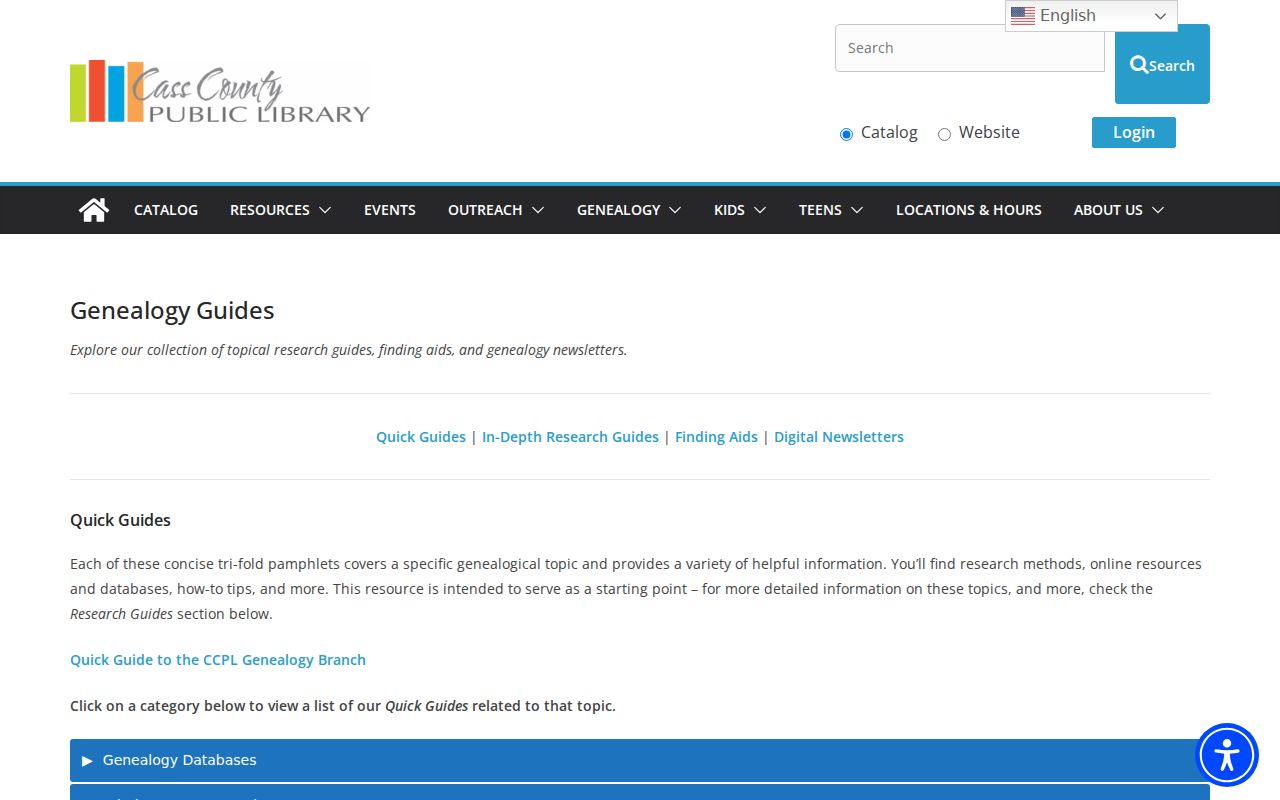
Start at the library's guide collection. It points to newspapers, local history files, microfilm, and databases, though no single shelf claims a complete run of annual Raymore directories. The genealogy inquiry route is a second channel. Call 816-884-6285 or write askgenealogy@casscolibrary.org. Staff capacity rules out full research service. CCHS helps by appointment instead. The address is 400 E Mechanic, Suite 203, Harrisonville, and the phone is 816-380-4396. Its archive page lists $7.50 for an obituary or marriage copy, while an older library guide quoted $5, so confirm the current amount before ordering.
Note: A page image, reel, book, folder, and repository name let anyone else retrace a family-history find.
Raymore City Directory Place Labels
Old Raymore entries need context before they make sense. The city's own history dates the first residence to 1871, the plat to 1874, and incorporation to 1877. Railroad service arrived in the 1880s and ended in 1935. Street names followed a pattern early on. North-south streets carried presidential names, while east-west streets carried tree names. Subdivision growth came later. Maplewood arrived in 1964, and Bridlecroft and Silver Lake followed in 1966.
A dated item may call the place Raymore village, township, a postal place, or a rural route, so keep the source's own label before adding context. For a current parcel or address question, the Raymore Street Directory workflow with the Assessor, GIS, Recorder, and a recorded plat fits better. The historical shelf answers a different question.
Trace a Raymore Directory Household
Begin with a name, street, parcel, or year. Keep each trail separate at first. Wait for dates and places to line up. The 1908 directory makes a good first stop for that year. A newspaper index or microfilm issue may fill a later gap, while CCHS family files, obituaries, marriages, probate records, taxes, and deeds can add a second source. Copy each page or reel reference. A name that vanishes may mean a move, a death, a spelling change, an omission, or a publication gap.
- Set the target year and place label first, including village, township, postal, or city wording.
- Inspect the 1908 volume or the relevant newspaper index, then save the exact book page or issue date and page.
- Check CCHS obituary, marriage, family, probate, or tax material and request the underlying image or copy where available.
- Compare grantor, grantee, legal description, spouse, and date in deed or tax sources without equating a property party with an occupant.
- Pair a historical directory year with the nearest released federal census. The 1950 census is the latest released decennial census under the 72-year rule.
- Keep conflicting names, spellings, and dates separate until independent records resolve them.
Never assume an annual directory exists for every year. The historical society, library, and state archives work better. The CCHS archive lists its categories and appointment route, and the Missouri State Archives local-holdings page points researchers toward state, county, municipal, and local-society repositories.
Raymore City Directory Timeline
Dates matter here. Sources from different eras show very different Raymores. These are collection and place-history markers, not evidence about any specific person.
- 1835: Cass County was organized, with early county records based in Harrisonville.
- 1837-1952: Cass deed indexes cover the period represented in the library’s microfilm and research holdings.
- 1874: Raymore was platted, creating an original street and lot framework for later address research.
- 1908: Webber’s county history and directory supplied the confirmed Raymore historical snapshot.
- 1950s-2010s: Library digital collections include memorial cards and obituary material for this broad period.
- 1980 forward: The library guide describes the Recorder web real-estate index as covering later records, while earlier material needs office, library, or CCHS work.
No courthouse fire haunts this county. The Cass library guide reports no known massive record destruction. A missing result calls for a spelling check, a repository check, a date check, or a custody check rather than a claim the record never existed.